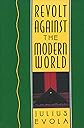

Desertcart purchases this item on your behalf and handles shipping, customs, and support to EGYPT.
📖 Unlock the ancient code to modern discontent — join the revolt against the ordinary.
Revolt Against the Modern World by Julius Evola is a seminal work analyzing the spiritual and cultural decay of Western civilization through a metaphysical and historical lens. It traces the loss of sacred tradition amid modernity’s rise, exploring themes from politics and social order to the cyclical nature of history and the Kali Yuga. This controversial classic challenges readers to reconsider progress, consumerism, and individualism, offering a radical call to reconnect with transcendent values and ancient wisdom across cultures.


| Best Sellers Rank | #36,729 in Books ( See Top 100 in Books ) #8 in Hermetism & Rosicrucianism #10 in Customs & Traditions Social Sciences #21 in New Age Reference (Books) |
| Customer Reviews | 4.7 out of 5 stars 806 Reviews |
T**R
Unclassifiable, important philological author
Readers with a good relationship to Frazier, Spengler, Gibbon and Heidegger will likely appreciate this highly philological and hermeneutical masterwork study of Evola’s on the mystical origins of social and political authority that became overturned as antiquity turned into colorless pale marble during the modernizing impact of Christianity over time, which is entirely reified and emptied out with the progressive arrivals of Protestantism, scientism, late phase capitalism, political ideologies and especially so-called “democratic” values in the West within the last few centuries (something now actually under review worldwide for good or for ill). As Evola explains, the seeds of modernity’s null and void spiritlessness were there earlier on, but ripened only as institutions of antiquity morphed and finally died out, once hallowed, now hollowed out of all sense and meaning. The sacred hides, we could extend this thinking, in soccer and football stadiums, election year political talking points, surviving but largely deadened modern religious ceremonies, in holiday celebrations and brand allegiances. Pale trades, all for sacred rites that once animated all of human life, hearth and home in all cultures. Evola argues those ancient viable and enchanting energies are still there, only we have changed, and they merely await our return after the last gasp of our civilization’s scientistic, bored, know-it-all deadpan spoiled adolescence. Evola is very possibly the Nietzsche of Modern-era Traditionalism, seeking to essentially undo the modern attitude and what many took to be the cultural destructive/deconstructive influences of the Masters of Suspicion like Freud and Nietzsche that later blossomed into our current sloppy, postmodern hyper-politicization of human life. The essential change? Evola says it’s our diminished capacity for the sacred at the hands of capitalist and anti-capitalist ideologies which, like Christianity, had no respect for antiquity as they were all equally pitted against dispelling the connection with the sacred. Rude the Tiger is his “introduction” to this book, and there he hopes to guide young men specifically to learn patience and flexibility in wait for their time, the return to the rule of a truly sacred and fully authentic source of personal experience and social authority, one that is wise to the tricks of what Heidegger might have termed a cultural “Techne” in the slavish service of mere technological development. Evola makes sense of historical fascism, which he had higher hopes for in its early days, but like Heidegger, was highly unsatisfied and even disgusted with the evolution of these right-wing movements that promised to return “national and cultural glory” to the Western civilization. In response to being called a fascist in his public trial, he rejected that category and replied he was actually a “suprafascist!” making it clear he did not find fascism to be adequate or right-wing enough, while implying fascism was too simple-minded, too compromised, too political, racist in the wrong ways (culturally is the right way, but not like you’re thinking) and ultimately too utilitarian for its own good, blowing the mental fuse of all within earshot and pointing clearly to the only evident fact: Evola is simply anti-modern, in favor of something more like a return to an original order of things, pro-antiquity, not pro western or pro white supremscy per se (he rejoices in the ancient traditional cultures of non-whites frequently and with fervor, and would support equally any and all foreign nationalist movements that overturn the modern order in their own context, as he would favor in our own). He was promptly acquitted of the charge of fascism amid what could only be called astonished, mass confusion. Evola was the arrival of a different type of antiquarian, but is an antiquarian toward some futural new mode, and is most “similar to” late Heidegger in this way. I’m somewhat convinced that late Heidegger, however, must have read Evola’s main works, as some sort of such influence is apparent in Heidegger’s later more classical formulation of a primordial “Fourfold”: Heaven, Earth, Man and the gods — a kind of new beginning for mankind after the final death-throws of modernity/postmodernity/history. As Heidegger famously says in his last days, only a god can save us. This may seem curious to readers of early Heidegger, but in light of the likelihood of his reading Evola’s masterwork here, seems predictable enough in hindsight.
Z**N
The individual in the world today is the "nomad of the asphalt"
Julius Evola says a lot that goes unspoken in this Kali Yuga/dark age. In a very real sense the world is lining up with with "New Russia against the west. It is shaping up to be a huge confrontation clearly Putain has read some of this material. Evola short definition of tradition. "The traditional world knew divine kingship. It knew the bridge between the two worlds, namely, initiation; it knew the two great ways of approach to the transcendent, namely, heroic action and contemplation; it knew the mediation, namely, rites and faithfulness; it knew the social foundation, namely, the traditional law and the caste system; and it knew the political earthly symbol, namely, the empire. These are the foundations of the traditional hierarchy and civilization that have been completely wiped out by the victorious "anthropocentric" civilization of our contemporaries. " He goes on to describe Royal tradition in great societies Egypt China ect. This is at times hard to take. but much needed critique of what some call the current dark age. For example Evola on the destruction of the family and women in Soviet Russia are "two sides of the same coin." On America "In America everything works toward this goal; conformism in terms of "matter of fact" and "like-mindedness" On the matter of leaving people alone. It has rightly been observed that every American (whether he be named Wilson or Roosevelt, Bryan or Rockefeller) is an evangelist who can- not leave his fellow men alone, who constantly feels the need to preach and work for the conversion, purification, and elevation of each and everyone to the standard moral level of America, which he believes to be superior and higher than all others. This attitude originated with abolitionism during the Civil War and culminated with the double democratic "crusade" in Europe envisioned by Wilson and by Roosevelt. And yet even in minor matters, whether it be prohibitionist or the feminist, pacifist, or environmental propaganda, we always find the same spirit, the same leveling and standardizing will and the petulant intrusion of the collective and the social dimen- sion in the individual sphere. Nothing is further from the truth than the claim that the American soul is "open-minded" and unbiased; on the contrary, it is ridden with countless taboos of which people are sometimes not even aware. Evola points out the individual in the world today is the "nomad of the asphalt" Again two sides of the same coin. "Is all this that far off from Lenin's recommendation to ostracize "every view that is supernatural or extraneous to class interests" and wipe out as an infectious disease any residue of independent spirituality? Does not the technocratic ideology arise both in America and in Russia from the ranks of secularized and all-powerful men?" Have women become strong under the Soviet and American system? Evola on women. Would seem horribly offsenive in some aspects The Soviet emancipation of the woman parallels that emancipation that in America the feminist idiocy, deriving from "democracy" all its logical conclusions, had achieved a long time ago in conjunction with the materialistic and practical degradation of man. Through count- less and repeated divorces the disintegration of the family in America is characterized by the same pace that we could expect in a society that knows only "comrades." The women, having given up their true nature, believe they can elevate themselves by taking on and practicing all kinds of traditionally masculine activities. These women are chaste in their immorality and banal even in their lowest perversions; quite often they find in alcohol the way to rid themselves of the repressed or deviated energies of their own nature. Moreover, young women seem to know very little of the polarity and the elemental magnetism of sex as they indulge in a comradely and sportive promiscuity. These phenomena are typically American, even though their contagious diffusion all over the world makes it difficult for people to trace their origin to America." Somewhat critical towards Nationalism "Even when nationalism speaks of "tradition," it has nothing to do with what used to go by that name in ancient civilizations; it is rather a myth or fictitious continuity based on a minimum common denominator that consists in the mere belonging to a given group. Through the concept of "tradition," nationalism aims at consolidating a collective dimension by placing behind the individual the mythical, deified, and collectivized unity of all those who preceded him. In this sense, Chesterton was right to call this type of tradition "the democracy of the dead." Here the dimension of - transcendence, or of what is superior to history, is totally lacking. " More in favor of caste "In the context of a living tradition, the castes represented the natural "place" of the earthly convergence of analogous wills and vocations; also, the regular and closed hereditary transmission forged a homogeneous group sharing favorable organic, vi- talistic, and even psychic proclivities in view of the regular development on the part of single individuals of the aforesaid prenatal determinations or dispositions on the plane of human existence. The individual did not "receive" from the caste his own nature; rather, the caste afforded him the opportunity to recognize or remember his own nature and prenatal will, while at the same Lime presenting him with a kind of occult heritage related to the blood so that he would be able to realize the latter in a harmonious way."
N**M
Restoration - The Return to Tradition.
The Modern Age is falling and the West is in an era of decadence. The darkest of all the dark ages, what the Hindus called the Kali Yuga, is before us and Ragnarok (Twilight of the Gods) is at hand. Tradition has been trammeled upon by modern utilitarian, pragmatist, and collectivist thought and the once sacred has been made profane. Mass-man is so caught up in collectivist thought and meaningless activity that he cannot be saved. Only a select group of elite traditionalists preserving the traditional Weltanschauung can restore a transcendent order to the world after the fall of this era. An ascetic neoscholasticism is needed to preserve the tradition intact while this cycle comes to an end. This is the message of Julius Evola in _Revolt Against the Modern World_. In this book, Evola fully dispels the modern myth of progress and reveals it as nothing more than a cover for a decadent society. Evola spends the first part of this book and much of the second part expostulating a traditional world order based on the idea of immanence-transcendence, before it's break-up at the end of the Middle Ages. He explains how an occult band of knights, members of the warrior caste, preserved tradition in the form of chivalry, during this period. However, with the advent of modern times, this tradition has largely been lost to us. Evola develops a myth of man's origins in a Golden Age, a Hyperborean race at the pole. A conflict developed between North and South, and between "solar" and "lunar" forms of religion. This conflict was at the heart of medieval Catholicism, and was reflected in the growing separation between priest and ruler. Originally, Evola argues, the Church sanctified the monarchy (the emperor) by a special rite. However, when this practice ended it made possible conflicting national loyalties to split up the medieval picture. With the Protestant Reformation which produced a strong emphasis on individualism more damage was done to the traditional world. As such, the world of tradition was lost and covered up by a world based more and more on utilitarian, hedonist, and ultimately collectivist principles, especially as witnessed in the French and Russian revolutions. This is the grim state of affairs we find ourselves in today. (Evola leaves off with a view of Europe "enclosed in the pincers" of America and the Soviet state, with America becoming more and more collectivist in nature and thinking.) Man must return to the values which are transcendent if he ever is to create a meaningful life. And, this is precisely what is absent from today's empty, hollow society. The philosophies of radical individualism and collectivism, nationalism and communism, pervade every aspect of our existence. And, we have lost much. Only by a return to tradition can we hope to achieve a new existence with a newfound meaning. Julius Evola was a fascinating character with much of interest to the dreamer and the mystic. Unfortunately, he allied himself with fascism briefly; however this is not the true basis for his thought.
S**U
don't need no prophets
Evola is the quintessential chider of our age....and this would be his masterpiece. It is heavy reading, and for most cartesian plebeians like myself, it takes 2 or 3 reads to fully grasp his "take" on history. Although not proven nor provable, this book is probably the closest one can get to the real history of mankind. What is amazing about this book is that he prophesized 911 or the like, but he also tells you that you don't need to be a prophet to see where this is all going. The chilliest part of the book is not anything he says, but actually the appendix where vedic prophecies exactly describes our times. He did not open the doors to no apocalyptic visions of reality, but mentioned that in fact, the change would be "not of this world", but of course that affects it in every way.
P**D
Highly Prophetic and a red pill to linear progressive nonsense
This is probably as important a book to read and much easier to find as “The Rule of The Inferiour” by Edgar Jung.Evola does an excellent job at explaining the decline of traditional values as long as the christization of The Catholic Church and how it lead to our Moden Crisis.He believes in the cyclical nature of time and that we are in the end of The Iron Age ,it could get much worse but thought metaphysical understanding the chosen must ride the storm out as one would in the center of a hurricane or the vortex of a black hole.The spiritual singularity has appeared to arrive and will wipe away this age of decay and disease.The false belief of humanism is evolving into the coming disaster of trans-humanism and those the the progressive sand faith will be drown once again in the rising tide.Everyday forward is another back to the past,Ride The Tiger people from The Polestar !
S**H
One of the greatest books I have ever read
One of the greatest books I have ever read. While I would not recommend this book to someone completely unaware of the Traditionalist worldview, to those who are it is like a divine revelation. "Beside the great 'currents' of the world there are still individuals who are rooted in terra firma. Generally speaking, they are unknown people who shun the spotlight of modern popularity and culture. They live on spiritual heights; they do not belong in this world. Though they are scattered over the earth and often ignorant of each other's existence, they are united by an invisible bond and form an unbreakable chain in the traditional spirit. This nucleus does not act: it only exercises the function to which the symbolism of the "perennial fire" corresponded. By virtue of these people, Tradition is present despite all; the flame burns invisibly and something still connects the world to the superworld. They are those who are awake, whom in Greek are called the εγρήγοροι."
A**R
Beautiful Printing
Haven't read this yet, but eagerly waiting to do so on my next plane ride in a couple days.
K**N
Opus Magnus of Traditionalist Critique against "modernism"
Before you buy any other of Evola's books, buy this one first, as it puts the rest of his thoughts into context (esoteric, cultural/political and otherwise). Well written, but very dense subject matter. Evola's writing, perhaps due to translation, needs to read and stewed over before you grasp what exactly he is trying to say. Whether you are just learning about this unorthodox thinker, or well versed in Traditional thought, this would be the book to start with. Evola also provides copious notes on almost every page, providing new paths of research for the curious. The one shame is that this book brings you up to 1969 (he died in '74), and I for one would have loved to have his take on the modern West. Physically a well made book, highly recommended.
R**O
Very good.
Book arrived in perfect conditions and shipping was pretty quick.
D**L
geld terug
is besteld en komt nooit aan blijkbaar is het beschadigd verstuurd en wacht nu al 3weken op mijn geld
V**E
Great Production
This is a wonderfully produced book. The writing itself is of course good, but it also has great art on the front, and a wonderful style to it. Many books I buy off of Amazon come looking used, or not amazing; but this book is by far the best I have gotten off Amazon. It looks clean, clear, and great. The paper is high quality, and the text looks very nice. Amazing work to whoever designed this book, as well of course to the writer, which you can find reviews of on here.
F**D
Recommended
This was the first Evola book I've read. I heard about it through history podcasts which referenced this particular work frequently. A basic outline of European history would be helpful for readers as Evola speaks on many historical personalities and events with an expectation that the reader is somewhat familiar with what he is referencing. It is a challenging book to read, in the best way possible, many paragraphs lead me to a long pause, contemplating his meaning before I could continue. It is clear from reading that Evola spent enormous energy on creating his weltanschauung and the wealth of knowledge he put together in this book is testament to that heroic effort. I will certainly be investing in more of Evola's works and highly recommend this book.
L**D
positive review
very interesting; good quality book and delivery
Trustpilot
2 weeks ago
1 week ago