Desert Online General Trading LLC
Dubai, United Arab Emirates
Desert Online General Trading LLC
Dubai, United Arab Emirates

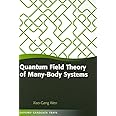
Quantum Field Theory of Many-body Systems: From the Origin of Sound to an Origin of Light and Electrons (Oxford Graduate Texts)
J**D
the beauty and the mystery of quantum many body physics. (in a unconventional new language)
It is a forward-looking and inspirational book. This book prepares many warm-up topics for ongoing research directions, such as string-net, toric code, topological order, nonlinear sigma model, emergent gauge theory, high Tc superconductor, etc. It is a good practice book to read for the backgrounds of hard-condensed-matter-theory and hard-condensed-matter-experiment.The reader, however, is required to be open-minded, and to be challenged by the unconventional, non-traditional ways of viewing the beauty and the mystery of quantum many body physics. It was suggested by the book that a new language is desired to describe the beauty and the mystery of many new emergent physics in the quantum world.
M**P
A Masterpiece
This book should be required reading for any student of modern condensed matter theory. Having prior exposure to the basics of condensed matter physics and introductory QFT would be very helpful, but besides that, the book is mostly self-contained. Most of the big topics of modern CMT are covered. If you don't know anything about a specific topic (spin liquids, fractional quantum hall, string-nets, etc.), this is a good place to start. If you know something about these topics already, this book will offer a fresh perspective and make you rethink past assumptions. Besides covering the core material very well, this book is most notable for its philosophical viewpoint. No other book paints such a vivid and coherent picture of what modern condensed matter physics really is and why it should be taken seriously as a fundamental theory. My only hope is that we eventually get an updated version. A lot has happened in the last decade! The book could especially use a section on SPT phases and an updated treatment of topological order.
R**S
I don't agree that fermions are non-local!!
This is a VERY difficult book. I think the first 6 chapters are FABULOUS. then Wen takes us into quantum hall effects and loses us!If you're well familiar with QFT in many body systems then this book has much to offer.Starting at chapter 9 he gets into his bread and butter of the speculative theory of string-nets. You won't find this topic in any other book so this is a valuable resource if you're curious as to how string-nets emerge gauge fields and all that.One thing that bugs me is his interpretation of fermions of the jordan-wigner transformation.He says that a spin 1/2 hubbard model is actually a bosonic model because you can also think about it as a system of bosons with hard core repulsion. Then he says it's amazing to see fermionic excitations emerge from a "purely bosnic model"But it's NOT "purely bosonic". We started with a Hubbard model and then in our head we "thought about it" as though they were bosons. I really don't understand his stance that the Hubbard model of spin 1/2 fermions is "purely bosonic"He doesn't explain in detail why he thinks this way...just that we can "think of it as bosonic"That bugs me. Spin 1/2 particles are fermionic!He also claims that fermions are non-local because you can use the jordan&-wigner transformation! In my mind this is nothing more than a mathematical device. But Wen considers this nonlocality in order to set up his stringnet perspectiveI digress.Otherwise this book is quite illuminating and enjoyable.
V**R
Good choice of material, but quite sloppy
The book contains very interesting choice of material, but the derivations are quite sloppy, the notation frequently changes without warning, and there is huge amount of typos. This is a kind of book that gives you some good insights (aka Feynmann's books), but certainly not the book from which you can seriously learn the subject.
B**T
Notoriously worse than Jackson in terms of skipping physical steps. Good guide to which physical problems are interesting?
The message this book has to the reader "in between the lines" is: "Here are some interesting calculations. I won't show you (at least not to the requisite level of detail) how to DO them, but I can tell you that they're interesting (much like a densely-written journal article). I also have some exercises for you, and I wrote them to emphasize the _physical_, rather than 'obtain equation such-and-such from equation so-and-so'.". The pile of books I have read through to see what steps have been skipped is noticeably larger than any other text. The author does make it clear that this is his intention, stating: "Novelty is more important than correctness" at the immediate outset (this is, in fact, the title of Section 1.6). The problem, of course, is that the student learning something for the first time must achieve 100% correctness as they work through to the conclusions that a text proposes; hence, we return to the problem that this text makes no effort to be pedagogical.In conclusion, think of this textbook as a collection of journal articles, but with exercises. Note, also, that ultimately in physics one is interested in the physical, rather than "drill" type or "checking/verifying" type problems (though the latter certainly arises in the context of research, it is always motivated by the physical). Perhaps it can be seen in this regard as doing its reader a favour by keeping their mind on the physical picture.This text would take a lifetime for someone like me to master, so take my review and rating with a grain of salt, for I certainly have not read through the book the whole way, and even if I did, I'm certain that later on the road of my physics-career (at the time of writing this, I am a PhD student), I might see the text with new eyes.
Trustpilot
2 weeks ago
1 month ago