Desert Online General Trading LLC
Dubai, United Arab Emirates
Desert Online General Trading LLC
Dubai, United Arab Emirates
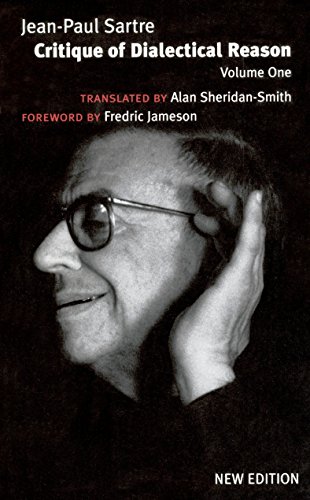
Critique of Dialectical Reason: Theory of Practical Ensembles
M**Y
Be prepared
Endless subclauses and qualifying commentary. Pages long paragraphs. Pages long footnotes. An interesting evolution of his thought in the Marxist dimension, but it is neither an easy nor a particularly fun read, more of a challenge.
R**N
Second Major Philosophical Work?
Let's assume that you think, as I do, that Sartre is arguably the greatest systematic philosopher of the 20th century for BEING AND NOTHINGNESS. Wittgenstein, his most original rival, started the "lingusitic turn", which appears to the deadest of dead ends for meaningful thought. Husserl was also a great thinker, but Sartre could be said to have completed his philosophy. Heidegger, who also influenced Sartre, seems ultimately to be a total faker (or do I mean fakir?), a pseudo-Buddhist who dictates his own unreasonable terms of "thought". (He writes a voluminous book about Nietzsche and bases it entirely on THE WILL TO POWER, which is arguably the least significant of Nietzsche's books.)Sartre the philosopher is great because he wrote BEING AND NOTHINGNESS. Two decades later he published the volume under review, ostensibly his second major work of philosophy.Both these books require the reader--especially the reader who isn't a specialist in philosophy--to, in Sartre's apt phrase, "break the bones in his head". For BEING AND NOTHINGNESS this is an effort well worth making. For the CRITIQUE ...Sartre's attempt to transmogrify phenomonological ontology into Communistic socialism comes a cropper. This makes it sound as if I've read the book with adequate understanding, which would be overstating the case considerably. I'll only say that BEING AND NOTHINGNESS was about individual consciousness, a subject amenable to convincing rational discourse, whereas THE CRITIQUE attempts to discuss collective consciousness in the same terms, and this, I'd argue, is an impossibility.I know I'll be told that Marx was first a philosopher, then a dialectical thinker, and ended as a theorist of economic reality and its ostensible consequences. But Marx was writing in the 19th century, Sartre was writing in the late 20th century, and not only was Marx wrong about the form the putatively inevitable revolution would take, social reality is now qualitatively different.To understand social reality now you have to know a great deal more about economics, sociology, and, most important of all, depth psychology than was known in Marx's or Sartre's time. I'll leave out neurology and brain science, a huge omission, but both Marx and Sartre ignore it.Hegel lurks behind both Marx and Sartre and, though perversely resurrected and revered by Kojeve and his ilk, Hegel was the most ludicrous thinker of his century, rightly reviled by Kierkegaaard, another misguided, if subtle, apologist for the Divine. He can't be ignored as part of the history of philosophy, but as a source of wisdom he's better left to oblivion.Sartre lost his sense of balance as he aged. His approval of "revolution" reached the barbaric stage of defending the killers of the Olympic athletes in Munich because, as he put it, the Palestinians had no other weapon against Israel except "terrorism". His argument that the horrors of Communism were insignificant because the underlying philosophy was ameliorative and Capitalism was exploitative makes me wonder if he ever heard the saw about "the road to Hell being paved with good intentions". Stalin, whom he defended, murdered millions: there's no way to read this without thinking that Sartre's mania not only ruined his life but that it contaminated his late philosophy.Arguably, he was better off as an anarchist, the apolitical genius who wrote NAUSEA and BEING AND NOTHINGNESS. If he'd written the "ethics" promised in the latter volume and ignored the nonsense of dialectical materialism, he would almost certainly have been a greater man and a greater thinker.
F**S
Sartre's last major philosophical work.
Seeking to give Marxism what Michael McGee called "a more rigorous intellectual defense," Sartre wrote volume one of Critique of Dialectical Reason (CDR) between 1957 & 1960; it was published in France in 1960. The first English edition appeared in 1976. A second, unfinished volume appeared posthumously in 1982.CDR was a massive attempt to describe the dynamic of various levels of human interaction & what characterizes these levels, from a mere chance collection of people to the social entity we call an institution. The ultimate objective was to show why Marx's categorization of "class" as some kind of hyperorganism was wrong. Its thesis statement can be drawn from its thematic antecedent, Search for a Method: cultural order is irreducible to natural order.In CDR, life was endless occasions of totalizations, detotalizations, & retotalizatons on a field of scarcity. These various totalizations were instances of human groupness, whether people waiting @the bus stop, a soccer team, or the "mob" storming the Bastille. We called the temporalization of events "history."First half of the volume, or Book I, is devoted mainly to ennui-provoking explanation of the dialectical investigation: hidden there in a footnote was Sartre's curt dismissal of Darwinism. However, he got wound up in Book II & showed how task assignments, division of labor, & the institution came about.I know of no other original study, treatise, or even novel that uses the themes & concepts of CDR. A CDR-oriented examination of, say, American domestic relations court proceedings (with its forced as opposed to mediated reciprocity) might be a worthy endeavor.
S**.
So Much
If you can read French, get the Gallimard.
Trustpilot
1 month ago
3 weeks ago